
Chiropractic Care for Patients With Spinal Fusions
Having a spinal fusion does not necessarily mean that chiropractic care is no longer an option.
With more than 60 years of combined chiropractic experience, the team at Enliven has treated many patients with previous spinal surgery and fusion involving the cervical spine, thoracic spine, lumbar spine, sacrum, and pelvis. These patients require a different approach than someone who has never undergone spinal surgery.
Our goal is not to manipulate a surgically fused area. Instead, we evaluate the fusion, the surrounding spinal segments, posture, movement patterns, muscle function, and the patient's current symptoms to determine what forms of conservative care may be appropriate.
Why a Spinal Fusion Changes the Way Your Spine Moves
Spinal fusion permanently joins two or more vertebrae to create stability and eliminate motion at the surgically treated segment. While this may be necessary to address instability, trauma, degeneration, deformity, or other serious spinal conditions, it also changes the biomechanics of the spine.
Because the fused segment no longer moves normally, the remaining mobile areas of the spine must accommodate movement around it. Over time, some patients develop degenerative changes in the levels immediately above or below the fusion. This is commonly referred to as adjacent segment degeneration. When those changes become associated with symptoms, the condition may be described as adjacent segment disease.
This does not occur in every patient, and spinal fusion is not the only factor involved. Age, pre-existing degeneration, the number and location of fused segments, spinal alignment, body mechanics, and other individual factors can influence what happens to the spine over time.
For this reason, we believe a history of spinal fusion warrants a careful, individualized examination rather than a one-size-fits-all chiropractic approach.
Chiropractic Care After a Spinal Fusion
Post-surgical patients often require modifications in technique, force, positioning, and treatment goals.
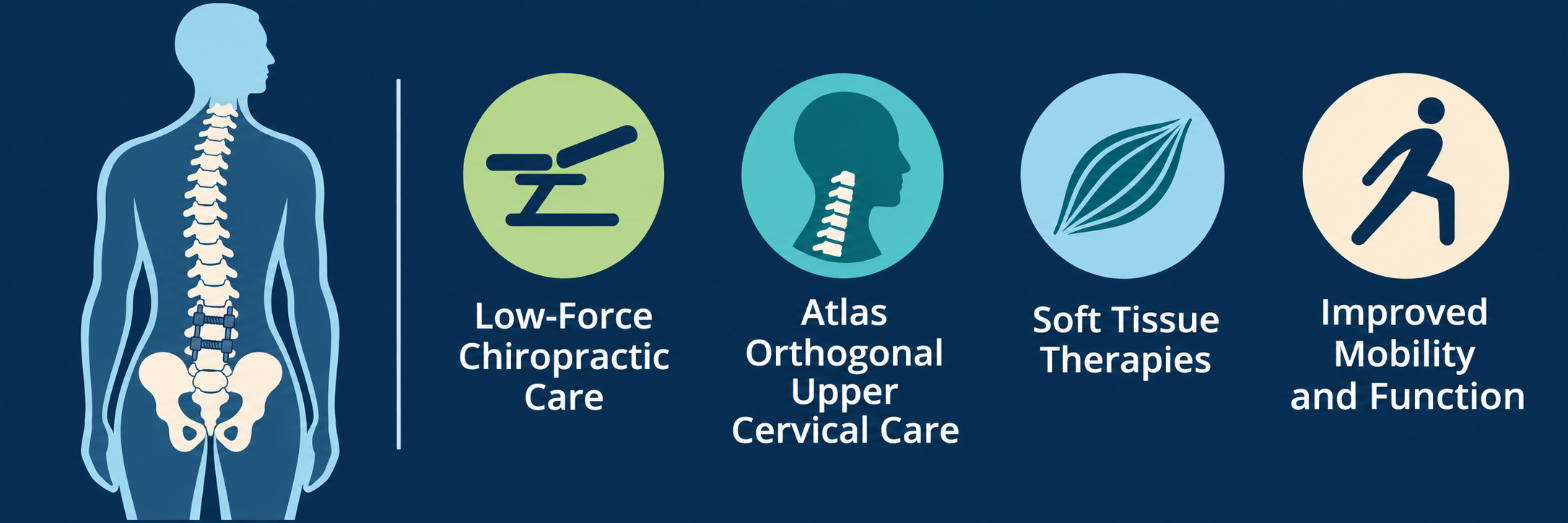
At Enliven, care may include:
Low-force, instrument-assisted chiropractic adjustments
Specific Atlas Orthogonal upper cervical care when clinically appropriate
Gentle mobilization of appropriate non-fused spinal regions
Soft-tissue and myofascial therapies
Light-contact neurologic and musculoskeletal therapies
Postural and movement assessment
Exercises or rehabilitation strategies designed to improve mobility, stability, and function
The techniques selected depend on the location and extent of the fusion, surgical history, current symptoms, examination findings, imaging when indicated, and the condition of the surrounding spinal structures.
We do not attempt to restore motion to a segment that has been surgically fused.
Protecting the Areas Above and Below the Fusion
One of the important considerations following spinal fusion is the health and function of the remaining mobile segments.
Changes in spinal mechanics after fusion can alter how forces are distributed through the spine. The segments adjacent to a fusion can be particularly important because they may experience altered mechanical demands.
Our approach therefore looks beyond the location of pain. We assess how the entire spine and surrounding musculoskeletal system are functioning, including posture, mobility, muscular tension, movement compensation, and the regions above and below the surgical fusion.
The objective is to identify areas that may be contributing to unnecessary mechanical stress while maintaining as much comfortable, useful movement as possible.
Treatment Focused on Function
Many patients with previous spinal fusion are not simply looking for temporary pain relief. They want to regain abilities that have become difficult.
Depending on the patient's condition, our treatment goals may include:
Reducing neck, back, or pelvic pain
Improving comfortable range of motion in appropriate non-fused areas
Reducing muscle tension and guarding
Improving posture and movement mechanics
Improving tolerance for standing and walking
Making bending and transitional movements easier
Improving the ability to work, exercise, travel, sleep, and perform normal daily activities
Treatment goals are individualized according to the patient's examination findings and functional limitations.
What If You Have Hardware?
Many spinal fusion procedures involve plates, rods, screws, cages, or other instrumentation. The presence of surgical hardware does not automatically exclude someone from chiropractic care, but it is an important part of treatment planning.
We want to understand what surgery was performed, which levels were fused, when the procedure occurred, and whether there have been subsequent complications or additional procedures.
When appropriate, previous X-rays, CT scans, MRI studies, operative reports, and other medical records can be reviewed as part of determining the appropriate approach.
A More Conservative Approach to Chiropractic Adjustments
Traditional high-force manipulation is not the only way to provide chiropractic care.
For patients with spinal fusion, previous surgery, extensive degeneration, or other structural considerations, we may use lower-force techniques and instrument-assisted procedures to deliver care without relying on aggressive end-range manipulation.
The objective is precision: determining where treatment is appropriate, where it should be modified, and where it should be avoided.
When Additional Medical Evaluation Is Needed
Not every symptom following a spinal fusion should be treated conservatively.
New or progressive weakness, significant numbness, changes in bowel or bladder function, severe or rapidly worsening pain, symptoms following a new trauma, or concern for surgical hardware or fusion complications may require medical evaluation or additional imaging.
When a patient's presentation suggests that further evaluation is appropriate, we can coordinate care or recommend referral to the appropriate medical or surgical specialist.
You Have a Fusion. You Still Have Options.
Living with a spinal fusion does not mean that every episode of neck or back pain requires medication, injections, or another surgery. Depending on the underlying problem, conservative care may be an appropriate component of managing persistent pain, stiffness, movement limitations, and functional problems following spinal surgery.
At Enliven, we take the time to understand your surgical history and how your spine functions now. From there, we develop an individualized treatment plan designed around your anatomy, your fusion, and the activities you want to get back to doing.
If you have had a cervical, thoracic, lumbar, sacral, or pelvic fusion and are wondering whether chiropractic care may be appropriate for you, schedule an evaluation with the Enliven team.